A New Display Case in the Electronics Mall
Spend an afternoon in the electronics markets of Shenzhen's Huaqiangbei district and you'll notice a display case that didn't exist eighteen months ago. Rows of glasses sit under glass, priced like premium sunglasses, each one promising to listen, translate, and see the world alongside its wearer. A shop clerk will hand you a pair with a camera hidden in the hinge and tell you, without irony, that this is what phones looked like right before everyone decided they needed one. He might be wrong. But the fact that the pitch sounds plausible at all says something about where East Asia's consumer electronics industry has decided to place its next bet.
The Category Google Killed and Meta Revived
Smart glasses have failed publicly once already. Google Glass launched in 2013 at $1,500, drew a wave of ridicule and a genuine privacy backlash — bars in San Francisco banned it outright — and quietly disappeared from consumer shelves within two years. For most of the following decade, "smart glasses" was shorthand in hardware circles for a category that looked good in a keynote and terrible in real life: heavy, socially awkward, and short on anything a phone couldn't already do better.
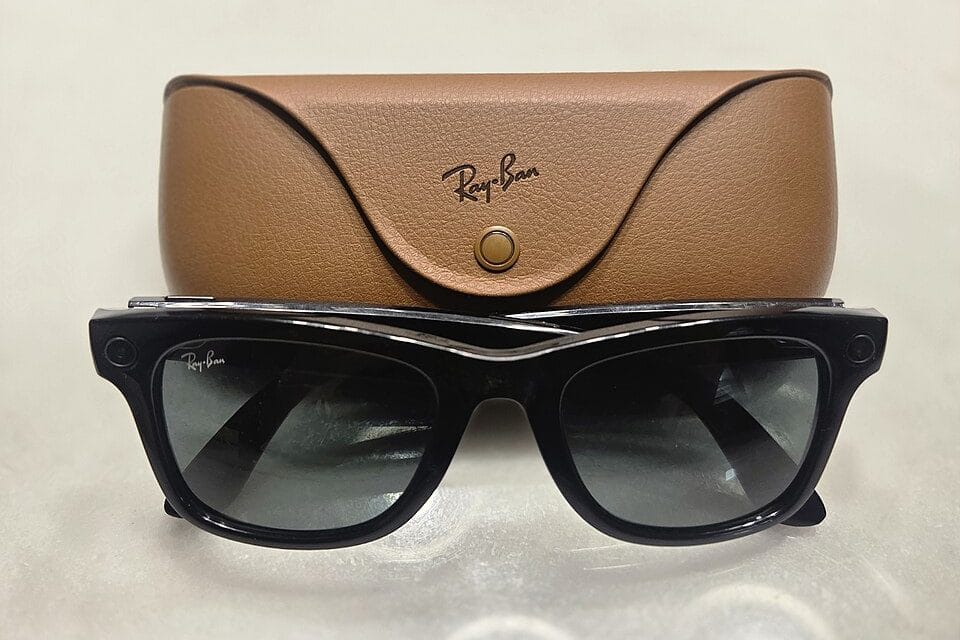
What changed the calculus was Meta's partnership with EssilorLuxottica, the parent company of Ray-Ban. Rather than chase a screen, the first generation of Ray-Ban Meta glasses shipped without a display at all — just a camera, open-ear speakers, and a voice assistant, wrapped in frames people would actually wear to a bar. They sold well enough, and looked normal enough, to convince component suppliers and device makers across Shenzhen, Hangzhou, and Seoul that the category wasn't dead. It just needed better manners.
Who Is Actually Building These in East Asia
The most visible activity sits with a cluster of Chinese startups rather than the household names. Hangzhou-based Rokid ships AI glasses in the $300–$700 range with cameras, microphones, and in some models a narrow waveguide display for translation subtitles or navigation prompts. Chengdu's INMO and the Beijing-founded Xreal occupy similar territory, competing less on brand recognition than on how fast they can ship the next spec bump. None of these companies has anything close to Apple-level global retail presence — most sales still happen through domestic e-commerce platforms and a handful of export storefronts — but they've moved faster than any Western competitor on price and iteration speed.
The Component Supply Chain Nobody Sees
Behind the startup brands sits a quieter, more durable business: components. Samsung Display and LG Innotek supply micro-displays and camera modules that end up inside glasses regardless of whose logo is on the frame, the same way Korean panel makers profit from phones they don't design. Japanese optics houses with decades of lens-grinding heritage — precision work that predates the smartphone entirely — increasingly license waveguide-etching processes to Chinese glasses makers rather than build consumer brands of their own. It's a familiar East Asian pattern: the flashy startup gets the headline, the component supplier gets the margin.
Why the Hardware Is Still the Hard Part
No one has solved the battery problem.
Glasses can't be heavy, which means batteries stay tiny, which means most current devices run four to six hours of active use before needing a recharge — usually from a case, the same trick wireless earbuds use. Push the frame harder, with an always-on camera or a bright in-lens display, and you'll notice the temple area gets warm after twenty minutes of continuous video, the same heat problem phone makers solved a decade ago by simply making the phone bigger. Glasses don't have that option. There's nowhere to hide a bigger battery on a face.
For now, the audio-first route Meta chose is the better bet than glasses built around an in-lens display. Waveguide optics remain expensive to manufacture at scale, the field of view is still narrow enough to feel like looking through a keyhole, and color reproduction on the display models lags well behind a phone screen — whatever the polished demo videos suggest at a launch event. A pair of glasses that just listens, sees, and talks back through a speaker is a simpler, cheaper, and more reliable product than one trying to paint a screen onto a two-millimeter strip of glass.
The Software Race Matters More Than the Frame
Increasingly, the differentiation isn't the hardware at all — it's what the assistant on the other end of the microphone can actually do. Real-time translation subtitles, visual search that answers "what am I looking at," and voice assistants that hold a genuine conversation rather than parsing rigid commands have become the feature that decides repeat purchases. Chinese glasses makers have leaned on the country's fast-moving open-weight model ecosystem to keep pace here without the licensing costs a Western AI partnership would carry, running lighter models on-device for latency-sensitive tasks and offloading heavier reasoning to the cloud when a connection allows it.
Price Wars Are Coming Before the Market Is Ready
Chinese consumer electronics has a well-worn playbook: flood the category with cheap hardware early, sacrifice margin, and let the market sort out which brand survives on volume. Glasses are already following the script, with unbranded models appearing on cross-border marketplaces for under $150. Cheaper isn't automatically better here, though — many of those budget units run cameras that lag a full second or two behind what the wearer is actually looking at, which defeats the entire premise of an assistant that's supposed to be paying attention in real time. Buy the $150 pair expecting a Ray-Ban Meta experience and you'll end up with a novelty item that spends most of its life in a drawer.
The more interesting price pressure sits just above that floor. As Rokid, INMO, and their competitors push toward the $300 mark, they're closing in on the psychological threshold where a curious buyer stops treating the purchase as a gadget experiment and starts treating it as a genuine phone accessory — something bought alongside a new handset rather than instead of one. Cross that line at real volume, with real repeat purchases, and component suppliers start building capacity assuming the category is permanent rather than a passing fad. Xiaomi's fitness bands crossed a comparable threshold near the $30 mark a decade ago, and volume did exactly what component suppliers hoped it would — it justified the tooling costs that made every subsequent generation cheaper to manufacture. That capacity decision, more than any single product launch, is what will determine whether AI glasses become a durable East Asian electronics export or a footnote next to smartwatches and 3D televisions.
What Could Still Kill the Category
Privacy is the obvious risk, and it hasn't gone away just because the frames look better than Google Glass did. A camera hidden in a hinge is still a camera pointed at strangers who haven't agreed to be recorded, and the "glasshole" stigma that sank the first wave of smart eyewear could resurface the moment a viral incident makes people self-conscious about being filmed by someone's face. Regulatory attention on biometric data and facial recognition already varies sharply across China, Japan, and South Korea, and none of that policy landscape has caught up to a product category shipping in the hundreds of thousands of units.
Whether AI glasses survive past the current wave of investor and press enthusiasm probably depends less on chip specifications or waveguide yield rates than on something much harder to engineer: whether strangers stop flinching when they notice the small lens by someone's temple. Component suppliers can fix battery life. They can't fix a social reflex.