South Korea's government unveiled a 16 trillion won ($10.3 billion) policy-financing package on July 1 to accelerate the adoption of physical AI — artificial intelligence embedded in robots, vehicles and industrial equipment — across six sectors it has designated as national priorities: AI infrastructure, robotics, future vehicles, defense, semiconductors and secondary batteries. The announcement extends the M.AX Frontier Project, the framework under which Seoul earlier this year identified semiconductors, physical AI and AI data centers as its three national megaprojects.
President Lee Jae-myung framed the financing as part of a broader "great leap forward" built on what officials call a "triple axis" of semiconductors, physical AI and data centers, appearing alongside the heads of Samsung Electronics and SK Hynix to announce the plan.
Robotics makers are among the first expected beneficiaries of the new financing. Hyundai's robotics unit and a cluster of Korean AI-vehicle startups had lobbied for dedicated funding since the M.AX Frontier Project was first announced, arguing that physical AI adoption in domestic manufacturing lags behind China and Japan despite South Korea's strength in the underlying chips. Officials said applications for the first tranche of financing will open to eligible companies later this month.
Fab Investment Reaches $518 Billion
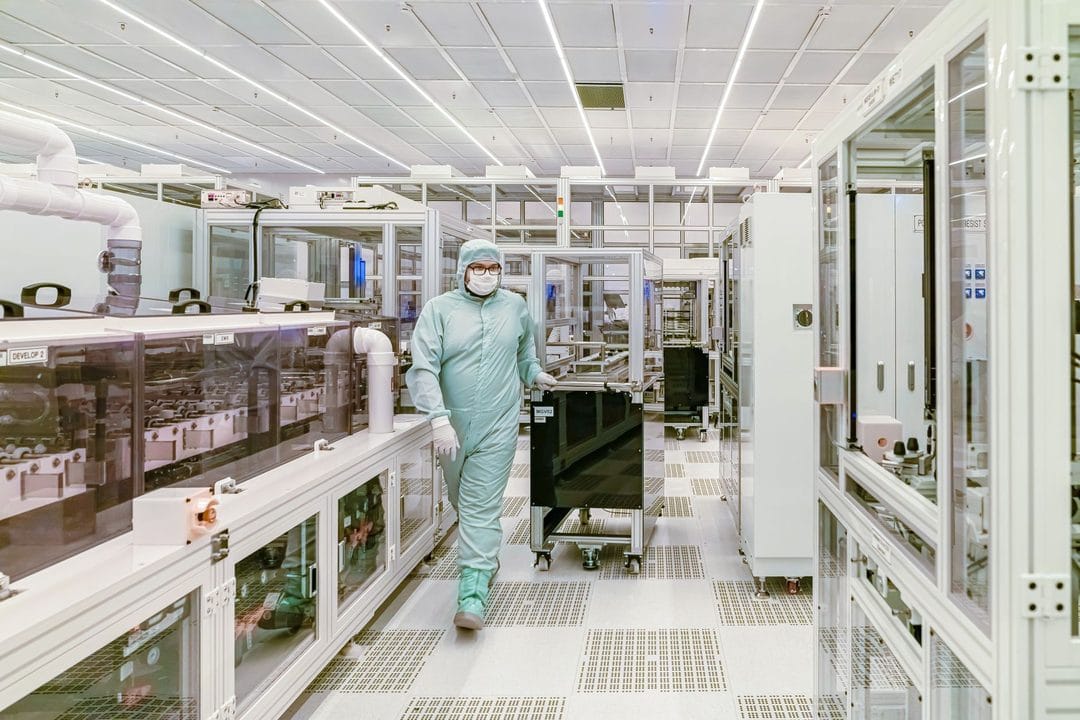
The policy financing follows a separate commitment from Samsung Electronics and SK Hynix, the world's two largest memory chipmakers, to invest 800 trillion won ($518 billion) together with suppliers on two new fabrication sites each in South Korea's southwest. A further 81 trillion won ($52.5 billion) is earmarked for a chip-packaging cluster in the Chungcheong region near Seoul, according to details released alongside the presidential announcement.
The Honam site selection has drawn criticism from opposition lawmakers, who argue the decision to locate a second semiconductor cluster in the region owes more to regional politics than industrial logic and accuse the government of pressuring the two chipmakers to support the choice. Both companies have declined to comment publicly on the site-selection dispute, referring questions to the Ministry of Trade, Industry and Energy.
Exports Cross $100 Billion in a Month
The investment drive comes as South Korea's trade data confirms the scale of current chip demand. Exports for June topped $100 billion for the first time on record, driven by semiconductor shipments that also set a monthly high, producing the country's largest trade surplus to date.
South Korea's position in the global AI hardware supply chain underpins the export figures. SK Hynix and Samsung together control roughly 88 percent of the market for high-bandwidth memory, the chip type used to train large AI models, while Taiwan's TSMC manufactures about 72 percent of global foundry output at leading-edge nodes. Goldman Sachs projects hyperscale cloud providers will invest more than $500 billion in AI infrastructure in 2026, nearly all of it dependent on chips fabricated in East Asia.
Taiwan's exposure runs the other direction: under a bilateral trade agreement signed with Washington in January, Taiwanese companies committed to invest $250 billion in U.S. semiconductor and AI-related projects, with Taipei extending a matching $250 billion credit line to firms making the move. The commitment has fueled debate inside Taiwan's legislature over whether the island is exporting capacity it will need domestically as global AI chip demand accelerates.
A Supply Chain Vulnerability Emerges
Not every input is under Seoul's control. A shortage of helium, used to maintain inert atmospheres in fab cleanrooms, has tightened since the war in Iran prompted Qatar — source of roughly 34 percent of global helium supply — to halt production. Fab operators in South Korea and Taiwan have not disclosed how the shortage is affecting near-term output, though industry analysts say cleanroom-grade helium has no readily available substitute at scale.
China, meanwhile, continues to narrow the gap in AI chip supply through domestic substitution rather than imports. U.S. regulators approved the sale of advanced chips to some Chinese companies as of June 17, but Chinese authorities have not cleared domestic AI firms to buy them, pushing local buyers toward alternatives such as Huawei's Ascend 910C processor. Roughly 65 percent of AI chips now in use in China are sourced domestically, according to industry estimates cited by Brookings.
The Pax Silica Declaration, a US-led coordination framework on advanced chip supply chains formalized in January with Taiwan's backing, now counts fourteen governments as signatories, including Singapore, Sweden, Qatar and India. Seoul has not disclosed how the new physical AI financing will be allocated among the six designated sectors, and officials say a sector-by-sector breakdown is expected before the end of the third quarter.