Shenzhou-19 Reaches Tiangong
China has successfully launched the Shenzhou-19 crewed spacecraft from the Jiuquan Satellite Launch Center in the Gobi Desert, carrying three astronauts to the Tiangong space station for a six-month mission. The crew — commander Cai Xuzhe, flight engineer Song Lingdong, and payload specialist Wang Haoze — docked with the station approximately six hours after launch.
Wang Haoze, 33, is the youngest Chinese astronaut to visit the station and only the second woman. The China Manned Space Agency said her selection reflects "a deliberate effort to diversify the astronaut corps and prepare for longer-duration missions, including eventual lunar expeditions."
Science Program
The Shenzhou-19 crew will conduct 90 experiments across materials science, fluid physics, space medicine, and Earth observation. A key focus is testing medical countermeasures for bone density loss and cardiovascular deconditioning — research directly applicable to China's planned crewed lunar landing, targeted for before 2030.
The crew will also install new external payloads using the station's robotic arm, including a high-resolution Earth observation camera and a cosmic ray detector. Two spacewalks are planned during the mission.
Station Status
Tiangong currently consists of three modules: the Tianhe core module and the Wentian and Mengtian laboratory modules. The station has a total habitable volume of 340 cubic meters — roughly one-third the size of the International Space Station — and supports a permanent crew of three.
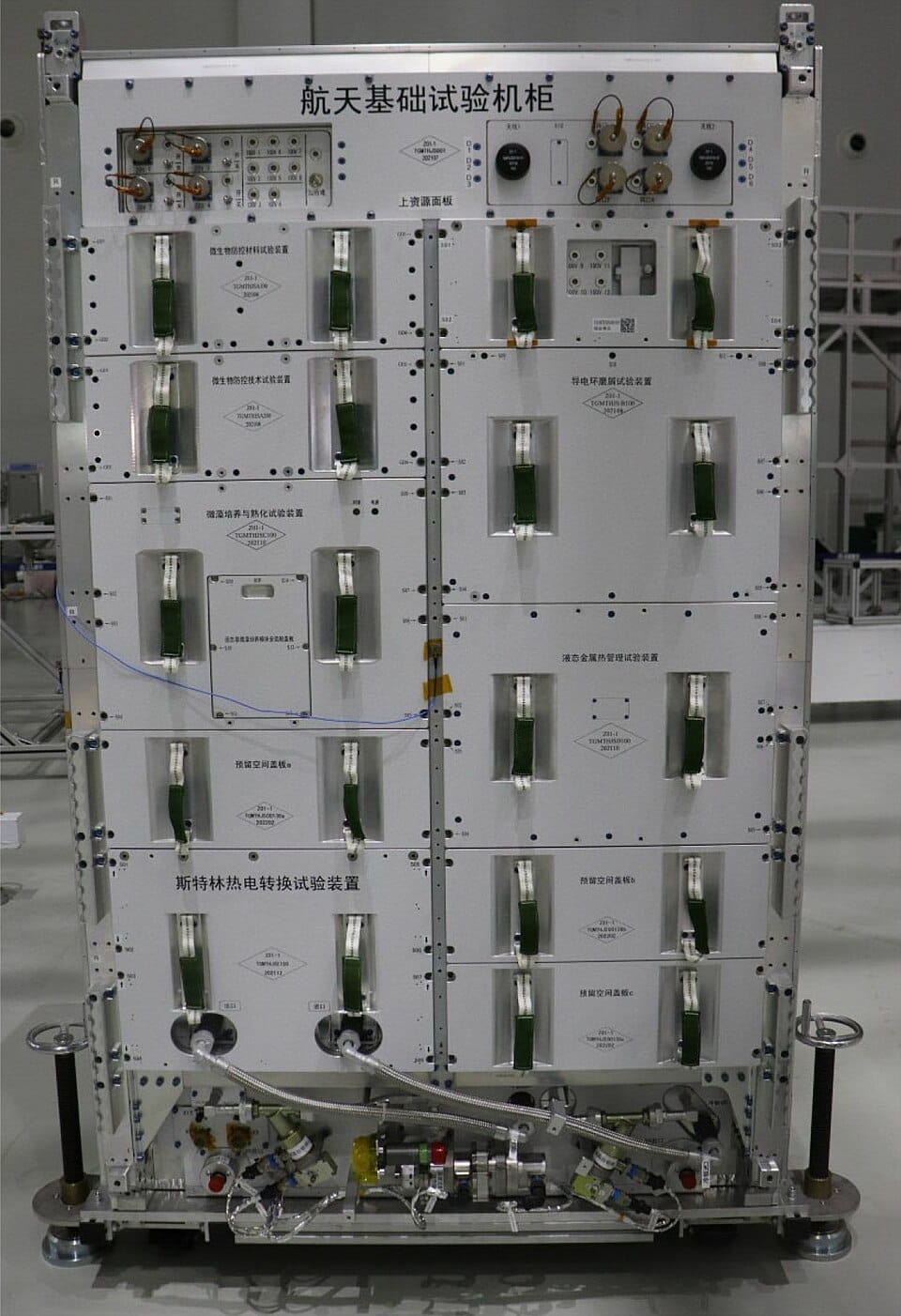
China has discussed expanding Tiangong with additional modules and has invited international partners to conduct experiments aboard the station. The United Nations Office for Outer Space Affairs has selected nine international experiments for Tiangong, including projects from Switzerland, India, and Nigeria.
Broader Space Ambitions
Tiangong operations are part of China's accelerating space program. The country successfully returned lunar samples with Chang'e 6 from the Moon's far side in 2024 — a world first. The Tianwen-2 asteroid sample return mission is scheduled for 2025, and a next-generation crewed spacecraft capable of carrying six astronauts is in development.
The United States and China remain barred from bilateral space cooperation by the Wolf Amendment. However, European and other international agencies have expressed increasing interest in collaboration with China's space program as the ISS approaches its planned retirement in the early 2030s.