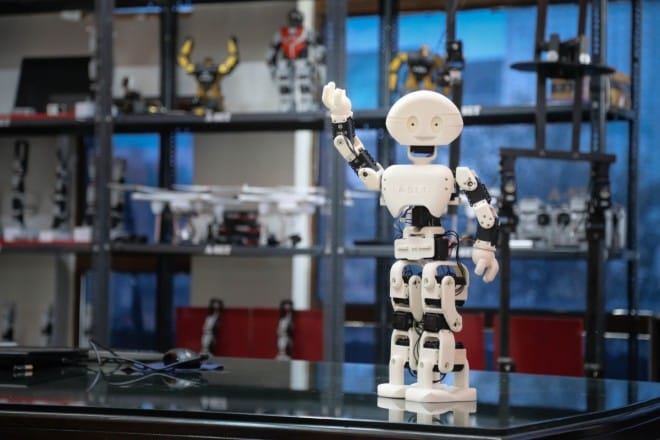
Unitree Scores Mega Round for Humanoid Push
Unitree Robotics has closed a $500 million funding round led by Alibaba Group and Hillhouse Capital, valuing the Hangzhou-based company at approximately $3.5 billion. The funds will be used to scale production of its G1 humanoid robot and develop next-generation models with improved dexterity and autonomous decision-making.
Unitree founder and CEO Wang Xingxing said the round "gives us the resources to move from hundreds of robots to tens of thousands." The company currently produces quadruped robots used in industrial inspection and research, and launched the G1 humanoid in mid-2025 at a starting price of $16,000 — a fraction of the cost of competitors from Tesla and Boston Dynamics.
G1 Capabilities
The G1 stands 127 centimeters tall, weighs 35 kilograms, and has 23 degrees of freedom in its joints. It can walk at up to 2 meters per second, carry loads of up to 3 kilograms in each hand, and perform basic manipulation tasks such as picking, placing, and sorting objects.
What distinguishes the G1 is its price point. Tesla's Optimus is priced at approximately $20,000 to $30,000 (estimated, not yet commercially available). Boston Dynamics' Atlas is not commercially sold. Figure AI's Figure 02 targets $50,000 and above. Unitree's $16,000 starting price puts humanoid robots within reach of mid-size manufacturers for the first time.
Target Markets
Unitree is targeting factory assembly lines, warehouse logistics, and agricultural operations. The company has pilot deployments at three BYD factories, where G1 robots perform parts sorting and light assembly tasks alongside human workers. BYD's head of manufacturing automation said the robots "handle repetitive tasks reliably, freeing human workers for quality control and exception handling."
Outside China, Unitree has received orders from Japanese logistics companies and European automotive suppliers. The company plans to open a sales office in Tokyo and a distribution hub in the Netherlands by mid-2026.
Technical Roadmap
The next-generation G2, expected in 2027, will add dexterous hands with tactile feedback sensors, enabling tasks that require fine motor control such as cable routing and electronic component insertion. Unitree is also developing a foundation model for robot control, trained on simulation data and real-world teleoperation recordings.
Goldman Sachs estimates the global humanoid robot market will reach $38 billion by 2035. If Unitree can maintain its cost advantage while improving capabilities, the company is positioned to capture a significant share of the industrial segment.